Infinite Universes: Secret Cave
Weary Knights, Shiny Altars & Heavy Gods (Czech Centre Paris, 2026)
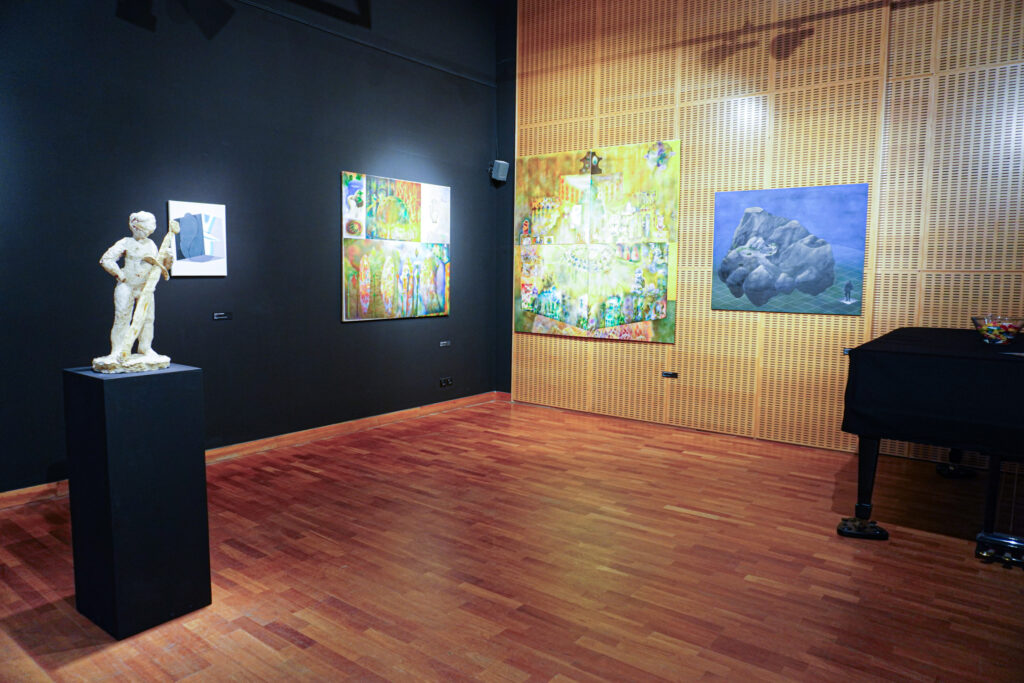
I curated a selection of Czech artists working with video game motifs for Czech Centre Paris as a part of the Infinite Universes game industry exhibition. Included: Klára Latta, Vojtěch Luksch, Alexandra Surovková, Argišt Alaverdyan, Matyáš Fiala, Amálie Dudová
We venture into virtual worlds every day. What happens when you swap the screen for a canvas?
A painter’s gesture, a handprint in clay, or a replica dagger can remind us that the seemingly obvious components of video games are the result of specific historical developments – and they imperceptibly shape our reality.
The Czech artists represented here take video game elements out of their original context and show them to us in a new light. They problematise narrative stereotypes (Amálie Dudová), comment on the logic of role-playing games (Matyáš Fiala) or create collages from user interfaces (Alexandra Surovková). They use a gaming perspective (Klára Latta), deconstruct the screens of canonical titles (Vojtěch Luksch) and blur the line between physicality and virtuality (Argišt Alaverdyan).
The ball of Ariadne’s thread begins to unravel. The quest begins.
My curator essay:
Infinite Universes: Secret Cave
Weary Knights, Shiny Altars & Heavy Gods
We tend to think of video games as a medium that transports us to other realities. We talk about a sensory immersion in the game world, as if the glow of the screen were pulling us out of the physical here and now and bringing us into a magic circle where special rules apply. At first glance, this makes sense – after all, video games are virtual. Simulations in which we become heroic knights or fearless soldiers, military commanders, sorceresses, amusement park managers, pilots, or the architects of the destinies of digital characters. And yet that’s not the whole story.
Although video games always take place through computer technology and can enchant us as audiovisual experiences, the idea that we leave our physical bodies behind when we double-click on an icon does not correspond to reality. The longer I think about games, the more I am interested in how they are experienced physically. Hands anxiously clutching the controller in a tense battle; groaning hips after a successful military campaign; a scream when a monster surprises us in a dark corridor; postponing a trip to the toilet when the story is developing in a suspenseful way. Emotions that pass through our fingertips, ears, and eyes, synesthetic and kinaesthetic pleasures that game designers count on – whether with good intentions (a combat system whose rhythm resembles playing the piano) or with calculated pragmatism (boxes with random outfits for game characters).
There are many established ways of thinking about video games, closely linked to the marketing efforts of game companies. Sometimes, we need guidance to help us see the whole situation with fresh eyes.
The works displayed as part of the exhibition Infinite Universes: Secret Cave / Weary Knights, Shiny Altars & Heavy Gods perhaps offer just that.
Video game influences and aesthetics are a natural part of the creative output of generations whose lives are inextricably linked to digital culture. It often seems as if fantastical fragments and motifs have become an aesthetic shortcut that can be used to evoke comforting nostalgia on the one hand and an impression of the mythical supernatural on the other – a little magic in a supposedly rational social system in which myths have seemingly disappeared. This exhibition draws on this tension, but at the same time deliberately transcends it. Because video game-inspired art is most effective when it avoids mere illustrativeness.
Although the artists presented here work with different techniques, their paintings and objects have one thing in common – they all take elements from video games out of their original context, transform them into objects of aesthetic contemplation and reverse our perspective. They adopt narrative stereotypes (Amálie Dudová), preserve the logic of role-playing games (Matyáš Fiala) and use traditional media to create collages from user interfaces (Alexandra Surovková). The artists use the perspective of a virtual game camera (Klára Latta) or directly deconstruct the screens of canonical titles (Vojtěch Luksch) or build a dream world in which the boundaries between physicality and virtuality are blurred (Argišt Alaverdyan).
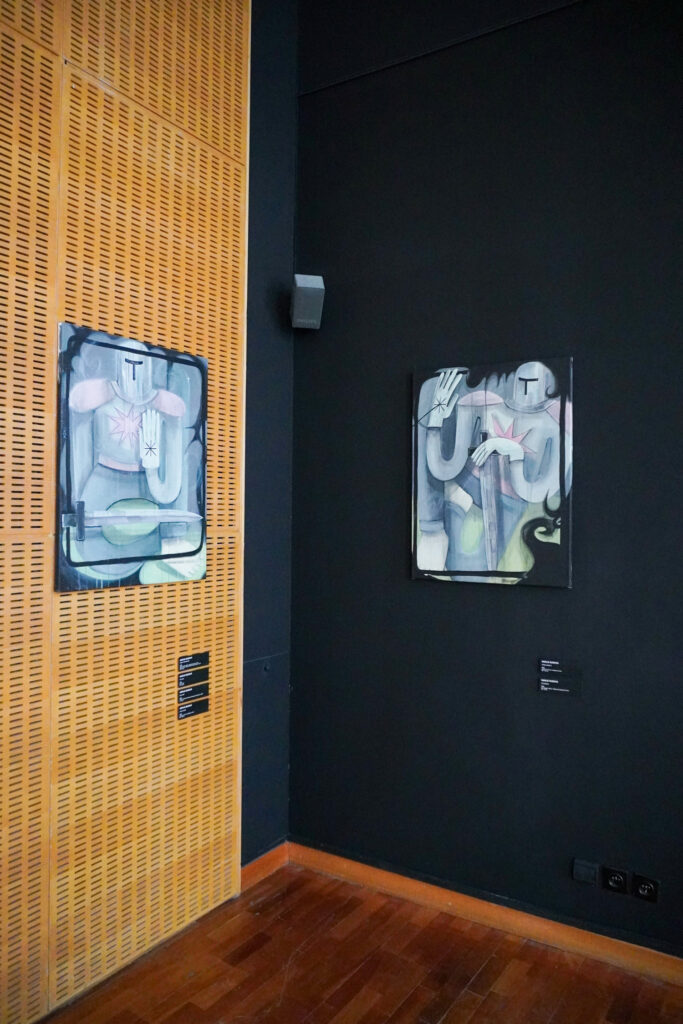
For some, the inspiration is more literal. When Amálie Dudová depicts a character in After a Quest who strikingly resembles the well-known melancholic knight from the Dark Souls series, she comments on the hero’s journey in an intermedia installation, forcing us to ask whether this template, familiar since the Odyssey, still applies, or why heroic (let alone medieval) epics still appeal to us in the 21st century. Dudová explores the fantastic fascination that permeates pop culture in many forms, from cosplay (dressing up in handmade costumes of favourite characters) to card games to collecting (is the dagger an object from the game or a souvenir?). And then there is the title itself. Where did the knight who set out on a quest, an expedition, disappear to? Or is it us who, after a virtual campaign, ponder what its meaning was and what prompts us to immediately embark on another?
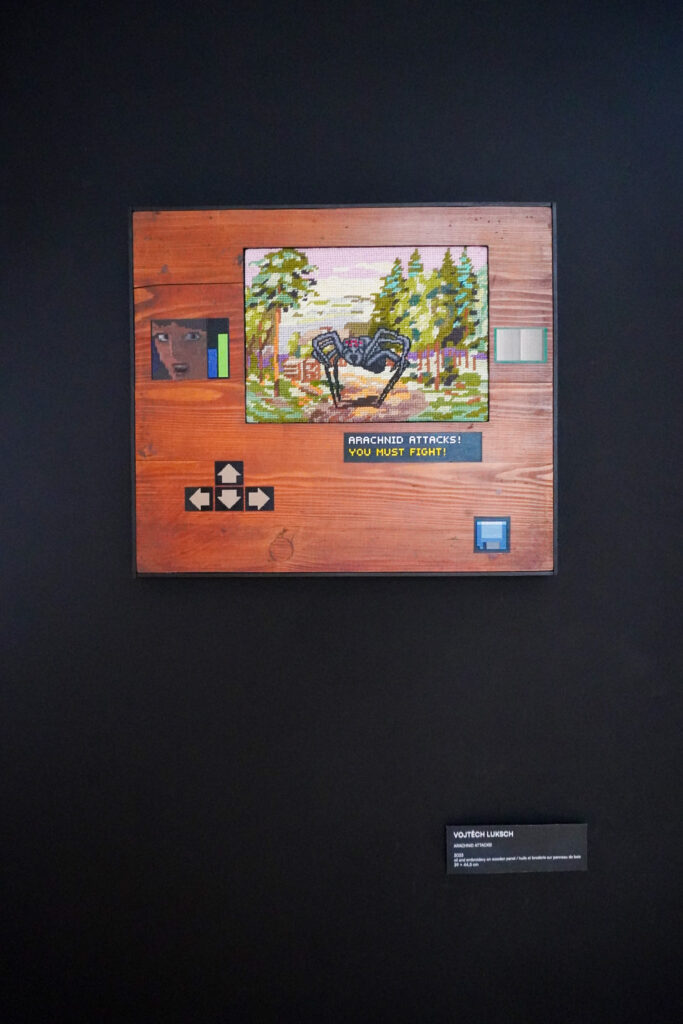
A pair of paintings by Vojtěch Luksch then works with the nostalgia evoked by the graphics of a now obsolete generation of game consoles. The metal base and inscription from the survival horror game Silent Hill or the battle with a spider from a role-playing game create an ambiguous tension – on the one hand, these are objects that seem almost soothing because they use an aesthetic vocabulary that we associate with a carefree childhood. On the other hand, they implicitly criticise the essence of such a retro-loving gesture by combining handmade techniques (textiles) with pixel art visuals. Was the past so pleasantly pixelated, or is it just an illusion of the flow of media time?
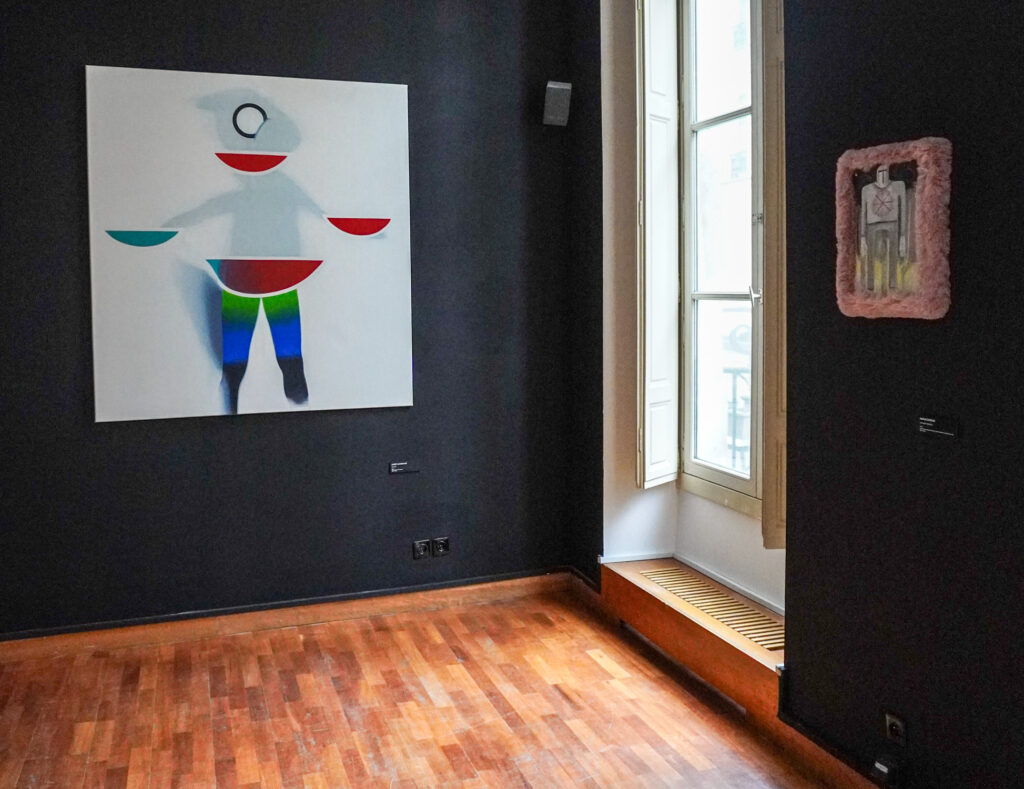
Elsewhere, the theme is the forces that affect us in virtual realities. Argišt Alaverdyan’s digital dictionary balances on the edge of painterly abstraction. Obvious similarities (such as genre conventions) give way to basic elements. Simple backgrounds reminiscent of the basic canvases of 3D modelling programs and game engines are overlaid with fragmented body parts, from limbs to digital chakras, a kind of force field, to an (elven?) face emerging from a cube. This may suggest that the boundary between the virtual and the real is permeable. It is a game of looks and identities, suggesting the ways in which the computer influences us when we play a game and how we influence it in return. The simply executed graphic elements seem to represent a layer that manipulates all of this, a means by which an invisible force rotates the game camera.
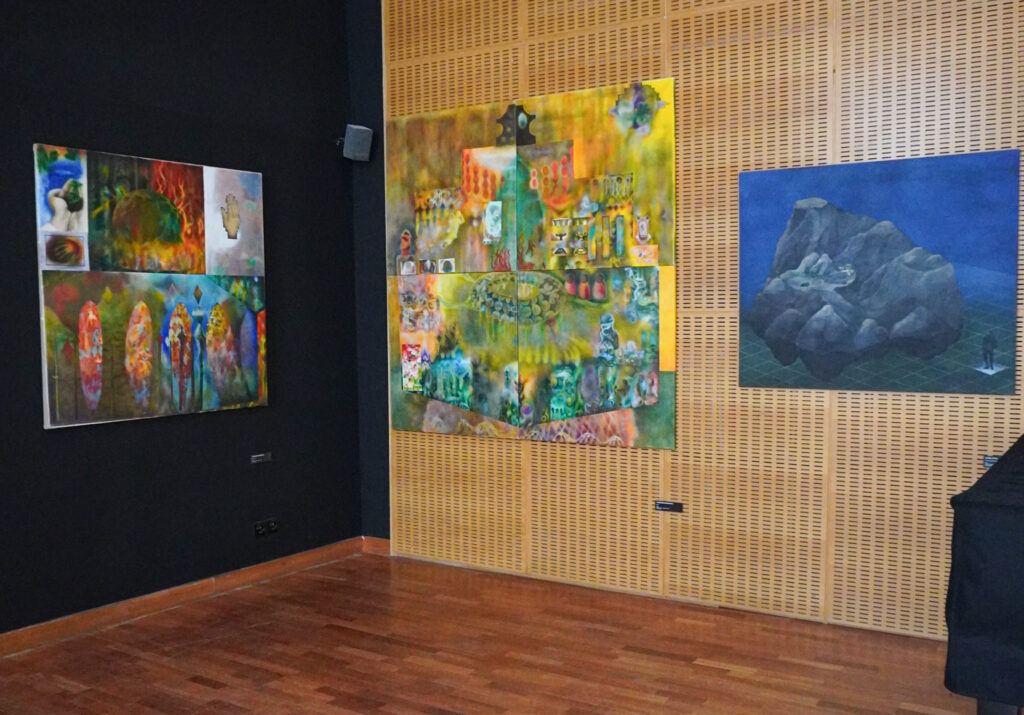
The question of perspective is also an essential part of Alexandra Surovková’s paintings. The Cartesian perspective gives way to a collage-like, flat layering with a delicate airbrush line; the surreal impression, bordering on the decorative and emotional, is bent by the striking teeth of a pixel art hand, the sharp edges of objects as if cut out from graphic software. The promise of transcendence (just look at the names, holy hands and altar) has long been associated with digital technologies – from the beginnings of Silicon Valley in Californian subculture to the word avatar, which in Sanskrit refers to the physical form of a god. The raw images are captivating and disorienting, as is the black mirror environment of the monitor, which conjures up an illusion of depth on the desktop.
The appropriation of the gaming perspective is evident for Klára Latta. The objects in her two paintings are anchored in a regular, so-called isometric grid: this evokes memories of evenings spent playing strategy games (Age of Empires, Starcraft), including the implied thickening fog (the fog of war) or the highlighting of the currently controlled character. Scale does not matter. Also: Who is the character in the corner? The author? Us, as we navigate the network of computational structures in everyday life? And when the second painting lights up, we discover that the network is not as regular as it seemed at first glance…
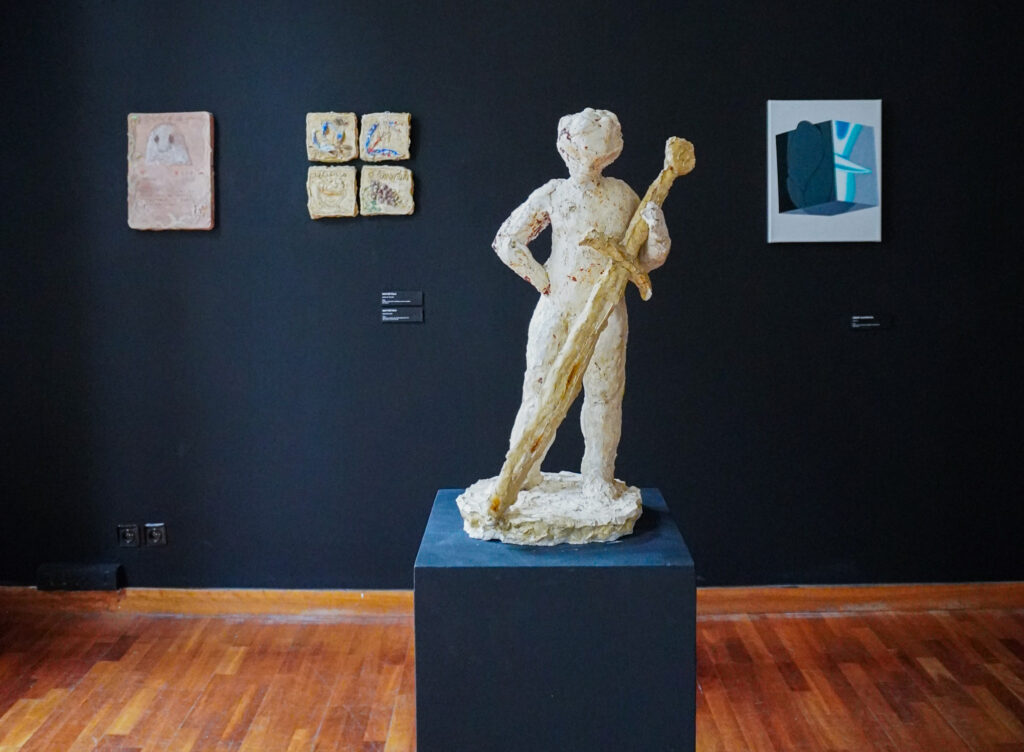
(Micro)transcendence can also be felt in the works of Matyáš Fiala. Blind demi-god, with his disproportionately large sword, evokes associations not only with gloomy Gothic games such as Elden Ring, but also guards a quartet of objects reminiscent of icons from an action RPG or decorations from some kind of shapeless temple. The weight of the material from which the loose ceramic blocks are made brings with it a monumentality (or perhaps an aura) that is characteristic of this trend in contemporary art. Fiala being more than just superficially captivated by fantastic motifs is evidenced by Ghost of the Past on the adjacent wall. The language of video games becomes a means of talking about difficult emotions. The self-ironic text and the smile of the cute creature indirectly refer to an illustrative style reminiscent of, for example, the charmingly disturbing adventure game Omori.
Narrative, materiality, cautious abstraction, clipping reverence, level editor perspective, and frozen mythology – these are all techniques that can be used to turn video game elements into objects of aesthetic reflection. It is precisely the materiality of classical media (the painter’s gesture, the imprint of a hand in clay, a hand-crafted replica dagger) that can remind us that all the seemingly unambiguous components of video games are the result of specific historical processes. User interfaces, control methods, types of emotional experiences, and the ways in which games treat our physical bodies – none of this exists in a vacuum but rather reflects our reality and at the same time helps to shape it.
Surovková, Luksch, Alaverdyan, Dudová, Latta and Fiala remind us that art can do more than “just” provide sensory pleasure; it can become a means by which we can see everyday reality in a new light. Just as games allow us to see the world differently, art can draw out from games what would otherwise remain obscure.
Whether exploring the essence of nostalgia or fantasy motifs with their myth-making power, breaking down game scenes into their constituent parts, or building altars inspired by digital perspectives, the works in this exhibition are traces of a reality that, outside the windows of the Czech House, increasingly resembles a video game.
The ball of Ariadne’s thread begins to unravel. The quest begins.
Loading…